How to Apostille a Federal Document Yourself (DIY Option)
Yes, you can do it on your own—prepare for delays, paperwork, and multiple trips to Washington, DC.
DIY Federal Apostille Guide: How to Authenticate U.S. Documents Yourself
Every year, millions of Americans need an apostille to use their U.S. documents overseas. Whether it’s an FBI background check for a visa, a marriage certificate for residency, or a patent for business abroad, understanding how to navigate the federal apostille process is essential. This guide provides the complete do-it-yourself instructions for federally-issued documents, plus insider tips from years of helping clients fix costly mistakes.
Shortcut: Don’t want to travel to DC or wait months for the mail? Our local team hand-delivers documents directly to the U.S. Department of State and returns scans in about 10 business days.
What is an Apostille?
An apostille is a special certificate issued under the Hague Apostille Convention of 1961. It verifies the authenticity of a signature, stamp, or seal on a public document so it can be legally recognized abroad. In simple terms: it proves your U.S. document is real in the eyes of another country.
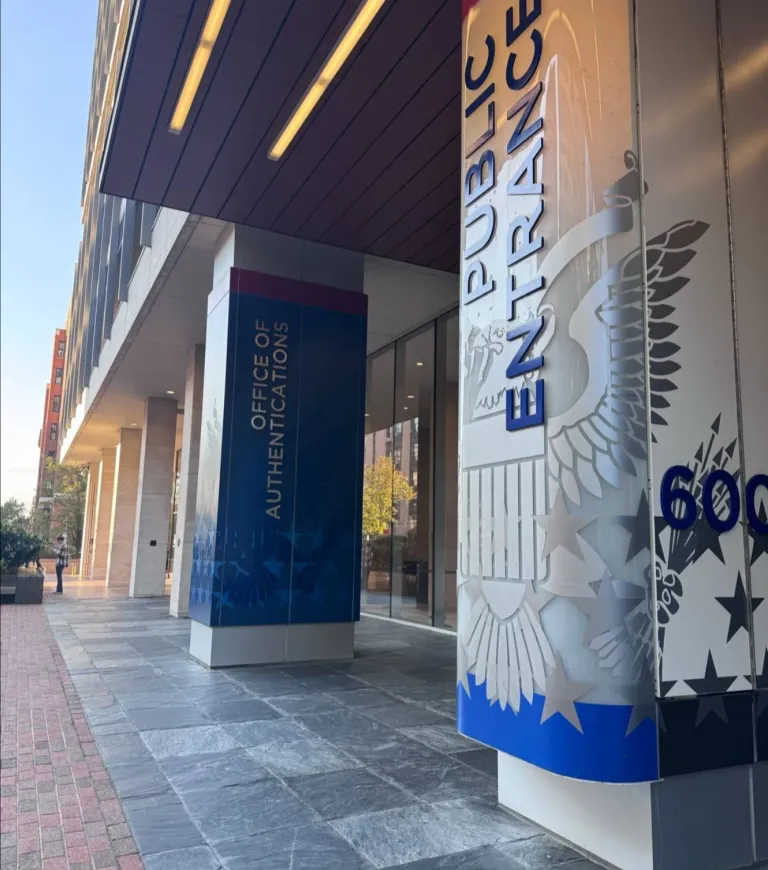
For federal documents (like FBI reports, USDA certificates, or federal court documents), the only authority that can issue an apostille is the U.S. Department of State Office of Authentications in Washington, DC.
Apostille vs. Full Legalization
The difference depends on where you’re using your document:
- Apostille — If the country where your document will be used is a member of the Hague Apostille Convention. Most major destinations (Spain, Italy, Mexico, Colombia, South Korea, etc.) fall into this category.
- Full Legalization — If the destination country is not a Hague member. Your document will first receive authentication from the U.S. Department of State, then additional legalization from that country’s embassy or consulate.
Example: A U.S. citizen moving to Spain for work only needs an apostille on their FBI report. But a U.S. citizen moving to the UAE requires full legalization — apostille from the State Department plus UAE embassy authentication.
Example: A U.S. citizen moving to Spain for work only needs an apostille on their FBI report. But a U.S. citizen moving to the UAE requires full legalization — apostille from the State Department plus UAE embassy authentication.
Which Documents Qualify?
Here are the most common categories:
1. Federal Documents
- FBI background checks
- U.S. federal court judgments and bankruptcy records
- USDA (animal/plant health certificates)
- FDA export certificates
- USPTO patent/trademark certificates
- Certificates from DHS, DOJ, HHS
2. State/County Documents
Examples: birth, marriage, and death certificates, divorce decrees, state court judgments. These are handled at the Secretary of State in the state of issuance, not the federal level.
3. Private/Notarized Documents
Examples: diplomas, corporate documents, affidavits. These usually need notarization first, then authentication at the state level.
DIY Step-by-Step Process for Federal Apostilles
- Get the original document — Must be issued directly by the federal agency with the proper seal/signature.
- Complete DS-4194 form — The Request for Authentications Service form. Destination country must be listed (missing this = rejection).
- Include payment — $20 per document, payable to “U.S. Department of State.”
- Submit your documents — By mail (address below) or by hand in DC (drop-off only).
- Wait for processing — Mail = months. Walk-in = ~10 business days, but requires two visits.
- Collect your apostille — If Hague member country, you’re done. If not, proceed to embassy legalization.
Mail-In Option
Mail your packet to:
Department of State
Office of Authentications
44132 Mercure Circle
P.O. Box 1206
Sterling, VA 20166-1206
Include:
- Completed DS-4194 form
- $20 per document (check/money order)
- Certified documents
- Prepaid return envelope (FedEx, UPS, USPS Certified Mail)
Warning: Mail-in applications are currently backlogged 2–3 months or longer. If you make an error, the packet will simply be returned.
Walk-In Option (DC Only)
If you live in DC or hire a courier, you can drop off documents at the State Department. Hours are limited to 7:30–9:00am. You’ll receive a receipt and pickup date (about 10 business days later). A valid ID is required at pickup.
How Long It Really Takes
- Mail-in: 2–3 months
- DIY Walk-in: 10 business days + two DC trips
- Courier service: 10 business days with no travel, scans sent immediately after pickup
Common Mistakes
- Forgetting to list the destination country on DS-4194
- Submitting state documents to the federal office (they’ll be rejected)
- Using personal FedEx Ground or UPS Ground for return (not accepted)
- Thinking “same-day” federal apostille exists (it doesn’t — only emergencies with proof)
Client Story: Lost Months, Then Help
A client once mailed her FBI background check directly to the State Department. Three months later, her packet was returned — she had forgotten to list her destination country on the DS-4194 form. By then, she had already missed her visa appointment. She came to us desperate. We hand-delivered her new packet, and within 10 business days she had her apostille in hand. Mistakes like this cost people months — which is why many choose professional couriers.
Frequently Asked Questions
Additional Resources
- U.S. Department of State Authentications
- Hague Apostille Convention
- Federal Apostille Processing Time (Delivery Estimator)
- Same-Day Service (Emergency Only)
Disclaimer: This page is for informational purposes only. Requirements and timelines may change; always confirm with the official U.S. Department of State.
TLDR; Can You Do-It-Yourself?
Yes, absolutely. The U.S. Department of State Office of Authentications does allow individuals to submit documents for apostille. But unlike state-level apostilles, federal documents must be processed only in Washington, DC. That means mailing delays (2–3 months) or physically appearing at the DC counter during its 90-minute morning window.
The Hidden Challenges
“This is why most attorneys, visa applicants, and expats rely on a DC-based service like ours to avoid losing months.”
|
DIY Mail-In |
 Federal Apostille (Expedited) |
|
|
Costs (Fees) |
$20 per doc + travel/postage |
✓ $149 flat rate (includes government fees + scans) |
|
Timing |
2–3 months by mail, ~2-3 weeks by walk-in |
✓ ~10 business days (hand-delivered & picked up) |
|
Location |
Must mail or show up in DC |
✓ Our team already in DC |
|
Risk of Rejection |
High if DS-4194 filled wrong |
✓ Reviewed before submission |
|
Scans Delivered |
No |
✓ Yes, included |
|
Tracking |
Not provided |
✓ Full tracking & receipts |
|
Consolidate with State Apostille Orders |
Not Available |
✓ Yes — we can combine federal + state apostilles |
|
Peace of Mind |
Stressful, risk of errors, no support |
✓ Professional review, guaranteed tracking, done right the first time |
How It Works
Get Your Apostille in 3 Steps

Checkout online.
Pay securely online — flat rate, government fees included.

Upload document.
After payment, securely upload your FBI report or federal document.

Get your Apostille
High-quality scans emailed in ~10 business days. Physical copies can be shipped for an additional fee.